Friday, February 26, 2010
Costa Rica, Pura Vida
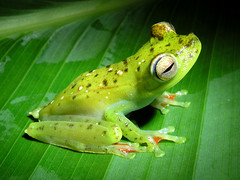
I haven't been working much in the field yet because our vehicle is out of commission. It broke down the day I arrived, so I've only worked two nights in the field...and by work, it was only three hours of looking for froggies instead of the usual six. However, we did find, just as we were wrapping up, an otherwise beautiful Scarlet-webbed Treefrog (Hypsiboas rufitelus) sitting atop a palm frond. Unfortunately, it had a serious case of chytrid fungus on its skin. Poor little guy.
On a brighter note, this little one, and presumably its family of five, decided to visit me at my office today (or rather, I saw jumping little red things and decided to catch one).
I've got more than 50 frogs whose Latin names I need to memorize. This little one isn't too hard to remember since, clearly, it's just a poisonous strawberry with blue legs. Yet of course there are a ton of other interesting wildlife to lolligag at, so hopefully I'll get to learn their names too (birds are a bit impossible, but I think I'll be able to cover the herpetofauna at the very least). If only I could finish my office/lab work...
Saturday, January 30, 2010
Chiapas, Mexico
Unfortunately, I have to keep this brief as my last post got deleted and the sun is out. Will update again soon.
Sunday, December 27, 2009
Christmas in Xela and a 2-month update
This past Christmas was the first time I spent the holiday away from my family. In Guatemala, everyone celebrates Christmas the day before. So, for Christmas Eve dinner, my flatmate and I baked our respective comfort foods: a pavlova (she's a Kiwi) and an apple crisp (I'm very North American). We then went over to my host father's aunt's house and watched Willy Wonka the remake, which was super creepy, and listened to firecrackers going off all over town. Everyone loves setting off fireworks in Guatemala to celebrate something, whether it's just a birthday or a national holiday, and so rarely a day goes by without me hearing them. It's also not just kids who do it. Even middle-aged folk have fun lighting them on the sidewalk and scurrying away to escape the deafening noise. But anyways, I digress. Once the clock struck midnight, the entire family and I went around the table hugging one another and wishing each other Feliz Navidad. It was very comforting for me to be welcomed into my host father's family, especially since I am so far away from my own. We then had a traditional dinner of paches as they say in Xela, otherwise known as tamales, the former being of potatoes, the latter of rice, before exchanging gifts.
On Christmas Day, some friends and I attended an epicurean potluck dinner at a communal yoga house. After satisfying our stomachs with macaroni and cheese, vegetable stew, mashed potatoes, and other savory delights, we sat around a fire ablaze in an old metal drum on the terrace, drinking wine and exchanging real life ghost stories. It was not something I would ever think of doing on or associate with Christmas, but it was certainly a memorably chilling night for all.
Today, I was supposed to go on a hiking trip but instead, I came down with a cold. Admittedly, I am feeling rather restless as I have been in Xela for nearly two months and am anxious to explore the rest of this incredibly beautiful country. The landscape, formed by volcanic activity, is nothing like anything I have seen before. From pine-cypress highland forests, to humid and misty cloud forests, to tropical lowlands and sunny beaches, Guatemala, as small as it is, has unbelievably rich cultural and biodiversity. It goes without saying that I have loved every hike I've gone on thus far and am eager to do more.
View of a chain of volcanoes from the top of Volcán Santa María
Looking down at Xela while descending Volcán Santa María
A sleepy morning in Santiago Atitlán, Lago de Atitlán
To update some of my older posts, I think my former Spanish teacher was a bit misinformed. There is a ton of foreign aid and investment in terms of development and well, the U.S. is “Guatemala's largest trading partner, providing 36% of Guatemala's imports and receiving 39.2% of its export.” There you have it. That means Levi's jeans are made in Guatemalan maquiladoras, labeled in the States, and sent back to Guatemala to be sold for an inflated price. What's more, I went to Xela's biggest paca, essentially a clothing flea market with piles and piles of clothes heaped on table after table, sometimes even in the bed of a pickup truck, most of which is sold for 1Q a piece (roughly 12 cents). While browsing through a row of jeans hanging on a wire, a familiar white and green tag caught my eye; it was none other than from Saver's, a thrift store chain I used to frequent quite often while living in the States.
On a brighter note, I would like to welcome the newest additions to our family.
Hamlet, the Great Dane. He's the biggest puppy I've ever seen.
Two new baby iguanas (other one not pictured).
I know bread's not exactly an animal, but it was a Christmas present I made for my host family because baking is something I have confidence in. Thanks goes to my father who cut out Jim Lahey of Sullivan Street Bakery's No Knead Bread recipe for me when it was first published in the New York Times back in 2006. I let the article collect dust in my desk for years until I had the guts to try baking yeasted breads last year. Since then, I haven't looked back.
Sunday, November 1, 2009
Las Aves
Wednesday, October 28, 2009
Food Production & Campesino Protestors
Another point in need of clarification is that the campesinos who are suffering the most from the drought are located in the corredor seco or the eastern highlands near the Pacific where the landscape is rocky and the soil so poor it is barely arable to begin with. Currently, the type of aid the government is giving consists of weekly packages of basic rations (eg. beans, rice). Despite the relative agricultural prosperity in other parts of the country, people in the west aren't getting local produce because they cannot afford it (and apparently neither can the government). No wonder there is talk of unrest. As we found out today, in anticipation of the protests, organizers of the cycling tour decided to change the route so that the cyclists wouldn't have to ride through an area of potential dissent. And so there we have it. Hopefully, the international aid that should have arrived today will help stave off malnutrition and starvation in that region for the time being. Ironically again, it is currently raining in Xela for the second night in a row.
Switching to our northerly neighbor, during "smoko" (aka mid-morning snack and tea time), we also read in today's paper that Obama has decided to dedicate significant funds to support renewable energy. Finally, some good news.
Tuesday, October 27, 2009
Second day in Xela
With that said, I didn't really get to see Xela that first night. My language school director quickly ushered me to my host family's house where my host mom gave me a warm welcome and dinner consisting of the traditional huevos, frijoles, y pan. The next day, from 8am-1pm, I went to class and began my struggle to say more than just si. I think I'm learning rather quickly, but it still feels incredibly isolating not being able to hold a real conservation with anyone yet. Por suerte, my host parents know a little bit of English, so we are able to communicate with one another in 'Spanglish', but needless to say, our conversation is extremely limited.
Nevertheless, I am quite fond of what I have seen of Xela. Each block usually consists of one large building subdivided into small shops that are differentiated by their variegating, brilliant colors. Every street, all made of variously sized cobblestone, is also one way which makes walking off the fairly narrow, elevated sidewalk easier if you know which way traffic is going. The only downside I have found so far is not being able to go out for a stroll alone at night for safety reasons.
This afternoon, my school and I went to see the home stretch of Guatemala's national cycling tour (vuelta de Guatemala) which is a huge deal here. Each segment of the tour takes place in a different part of the country; this morning, the cyclists started riding from the coast and finished in Xela, an elevation gain of over 2,000 meters. Intense, to say the least. Because this competition is so popular, there were rumours of a farmers' protest that threatened to interfere with the race in order to garner publicity. Guatemala has suffered from a particularly severe drought this year, especially in other regions of the country (Xela is fortunate not to have suffered as much), and so people, mainly in rural areas, do not have enough food to eat. Apparently, government aid has not been sufficient, and so farmers want higher subsidies. Although Guatemala has a president and congress, citizens actually do not have much sway over their elected (and sometimes appointed) officials, therefore, they rely on protests and the news to express their opinions. However, no protest took place today which leaves me wondering what happened.
Ironically enough, after the race, I walked through an impressively large farmers' market brimming with fresh produce. Completely lining the streets were Mayan women sitting by their large wicker baskets which overflowed with fruits and vegetables. These, I was told, were the leftovers of produce not exported to the U.S. for whatever reasons. Kind of like locally grown coffee, the finest ground is sent to the States while Guatemalans drink commercially produced, instant coffee at home; local, high quality coffee is simply beyond the means of the people who produce it.